Business Succession Planning: How to Plan Your Exit 💼🔑
Most business owners spend years building their company.
Very few spend the same time planning how they’ll leave it. 😅
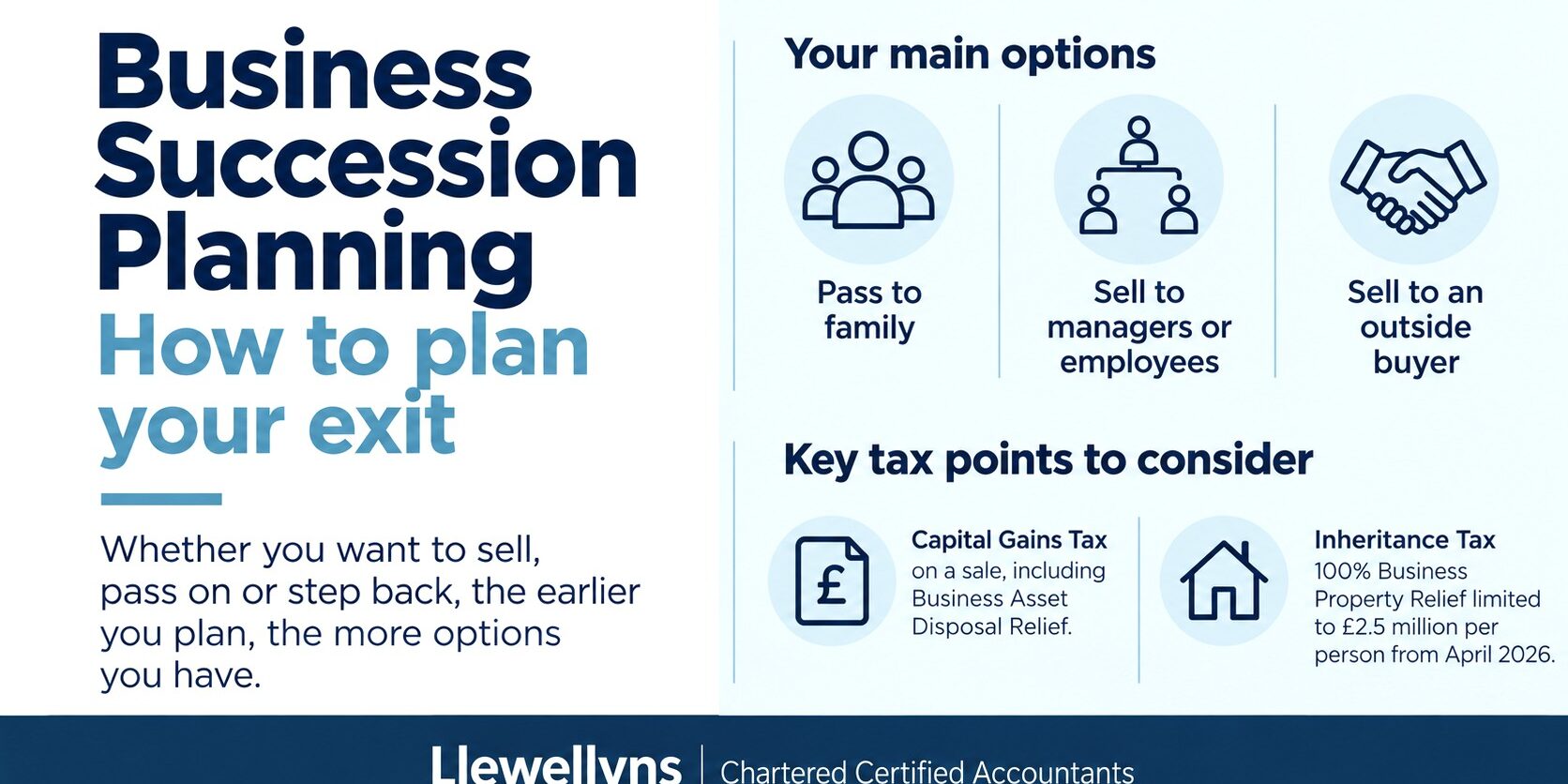
Whether you want to sell, hand the business to family, or step back gradually, the earlier you plan, the more options you have, and the less tax you may end up paying. 👇
🤔 What is business succession planning?
It’s simply deciding:
✅ Who will take over, or buy, your business ✅ When you want to step back ✅ How the transfer will happen ✅ What it will mean for you financially, and for your family
It isn’t only for people planning to retire next year. A good plan often starts three to five years before you want to step back.
🛣️ Your main options
There are three common routes:
🔹 Pass it to family: keeps the business in the family, but needs careful tax planning and a clear plan for who does what
🔹 Sell to managers, employees or co-owners: can reward the people who helped build the business, and may be done gradually
🔹 Sell to an outside buyer: often the biggest cash payment, but needs a business that can run without you
There’s no single right answer. The best route depends on your goals, your family and the type of business.
💷 The tax points to understand
The tax rules have changed recently, so it’s worth checking your position.
If you sell the business or shares
You may pay Capital Gains Tax on the profit. Business Asset Disposal Relief can reduce the rate on qualifying disposals, but the rate and conditions have changed, and the relief is limited.
If you pass the business on, or on death
Inheritance Tax matters too. Business Property Relief can reduce or remove IHT on qualifying business assets, but from 6 April 2026, 100% relief is limited to £2.5 million per person. Value above that qualifies for 50% relief.
For example, ignoring other reliefs and allowances:
💷 Qualifying business interest: £3 million 💷 First £2.5 million: 100% relief 💷 Remaining £500,000: 50% relief, so £250,000 is taxable 💷 IHT at 40%: roughly £100,000
(This is just an illustration. Your own position will depend on your circumstances, and unused allowance can sometimes be transferred between spouses.)
That’s why planning early matters.
📊 Step 1: Know what your business is worth
Many owners don’t have a realistic idea of their business’s value.
A valuation helps you:
✅ Understand your tax position
✅ Set realistic expectations on price
✅ Plan for shareholders, family members or buyers
✅ Decide if now is the right time to act
🧾 Step 2: Review your structure
Sometimes the structure of the business, such as a holding company or a different share structure, makes a succession plan simpler, or more tax-efficient.
It’s much easier to do before a sale or transfer than in the middle of one.
📄 Step 3: Put it in writing
A plan only works if everyone knows what it is. Consider:
✅ A shareholders’ agreement ✅ Up-to-date wills that reflect the business ✅ A plan for who handles key customers and suppliers ✅ A clear timetable
Our advice is always to involve your solicitor and, where relevant, your financial adviser too.
✅ A quick succession checklist
✅ Do you know what your business is worth? ✅ Have you decided who you want to take over? ✅ Do you know the potential Capital Gains Tax and Inheritance Tax position? ✅ Does your business run without you for a few weeks? ✅ Are your wills and shareholder agreements up to date?
If you answered “not sure” to any of these, that’s a good place to start.
📞 Want to talk it through?
At Llewellyns Chartered Certified Accountants, we help owner-managed businesses with valuations, tax planning and ownership changes, explained in plain English and with no pressure. 😊
We offer a free, no-pressure initial chat, so you can find out where you stand.
📍 Cardiff: 02920 624230 📍 Tonypandy: 01443 303230 📧 info@llewellyns.co.uk
Please Contact Us To Arrange Your Appointment Before You Arrive
Find Us In Cardiff
Tel : 029 2062 4230
Find Us In Tonypandy
Tel : 01443 303230